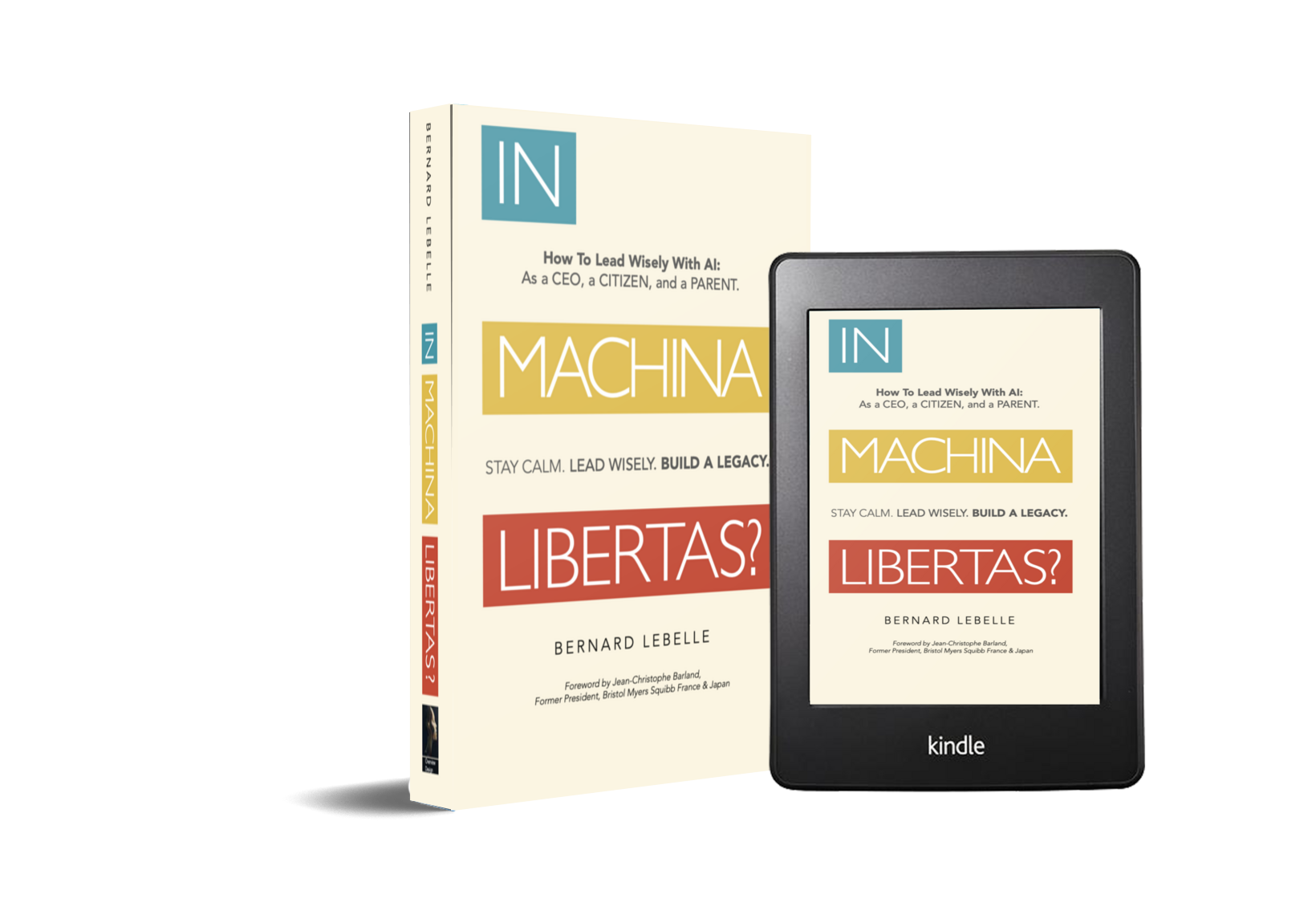
True Leaders Choose Augmentation, not Replacement!
In Machina Libertas? is not a book on AI Transformation in the traditional sense. It is not a step-by-step consulting methodology blueprint with checklists. It is not a philosophical essay on what Artificial Intelligence means for mankind. It is not a Gen AI prompt & context engineering training manual.
In Machina Libertas? is a practical decision-making framework designed for corporate leaders aiming to effectively utilize AI to generate resilient value across three crucial areas: their company (as a CEO), society and social structures in which the company functions (as a Citizen), and the upcoming generation entering the workforce (as a Parent).
I am breathless at the speed of AI adoption, but I’m also breathless at the speed of AI technology progress and improvements. The thinking and reasoning capabilities of AI are now able to replicate the cognitive skills for which white-collar and corporate leaders are paid.
Which means the temptation to replace staff with more “capable,” read “zero-payroll budget,” AI Agents and models is simply too great to ignore in boardroom discussions. And media headlines throughout 2025 and 2026 have only confirmed this trend.
But is the employees-replacement strategic move truly the cleverest one?
In Machina Libertas? is also a personal thesis on how to lead wisely with AI. I will argue throughout the book that corporate decision-makers have to navigate a narrow path between the temptations of Predatory Replacement and the benefits of Responsible Augmentation when designing their company’s AI Transformation Strategy.
Predatory Replacement takes the immediate gain and moves on. It treats this quarter’s earnings as the objective. It consumes capability, narrows opportunity, weakens trust, and transfers costs to employees, customers, communities, and the future.
Every predator eventually runs out of prey.
Responsible Augmentation does more than add efficiency. It develops people, preserves judgment, strengthens the organization’s capability base, and creates value that can endure.
Augmentation leaves the organization stronger than it found it, and expands future choices rather than narrowing them.
A real transformational leader makes this choice explicitly. Because long-term consequences far outweigh the short-term profit of the predatory path.
This book is divided into three sections. In each chapter, you'll learn about the current state of AI, the potential consequences of unchecked adoption, and how, by examining real-world companies and organizations, we can lead wisely and responsibly.
Section 1: As a CEO: You decide whether AI weakens your organization or strengthens it, whether authority migrates to the model or stays with people you can hold to account.
Section 2: As a Citizen: You decide whether your firm threatens the customers, workers & institutions the economy needs - or helps build the foundation everyone, including you, will stand on.
Section 3: As a Parent: You decide what your children inherit: a world that taught them to think, or one that taught them to outsource thinking before they ever learned how.
Five Appendix sections are designed to assist you in your continued journey. These include:
- An AI Transformation à la In Machina Libertas? checklist
- A Lexicon covering 75+ key concepts I believe corporate leaders should know, such as the Shadow Payroll. Spoiler: that’s for Chapter 5
- An Atlas of Role Models featuring inspiring companies and organizations
- An index of concepts to make it easier to revisit throughout your AI Transformation journey
- An index of insights from academic, business, and media sources, identified by numbers (e.g., 123), for further exploration
Before you start your learning journey, remember that AI Transformation is not a goal in itself - it is a means to achieve the greater common good.
So, stay calm, lead wisely and build a legacy.
A Letter to Your Future Self
Dear Reader,
You may have expected a different kind of letter—one that predicts who you will become and congratulates you on your arrival. But you already know who you became. That is why you are reading this. In the years ahead, three objects will sit on your desk.
The first will be your company’s latest organization chart. Look at it closely. It will map the true architecture of what you built with AI. You will know instantly whether the people on that grid grew more capable under your watch—whether they gained stronger judgment, sharper skills, and greater resilience.
Or, you will realize that the firm has succumbed to an invisible dependency, relying on complex systems it no longer fully understands. Did you use technology to elevate your people, or did you use it to automate away the friction through which leaders are forged?
The second object will be your pension statement. You belong to the first generation that will retire into an economic landscape your own decisions engineered.
The number at the bottom is an absolute reality, not an abstraction. It is bound to markets driven by the companies you built, the customers you chose to include or exclude, the talent you developed or abandoned, and the social contract you either fortified or let erode. You will live out your days inside the world you designed.
The third object will be a picture of an empty chair. Perhaps it belongs to an apprentice, a graduate, or a child who needed someone to explain not just how the work is done, but why it matters.
Someone was meant to sit there to inherit human judgment—not a static procedure, a sterile prompt, or a polished, synthetic answer.
Judgment is the earned, contextual wisdom that a machine cannot log, code, or inherit. Ask yourself if that transition ever happened.
Or did you outsource the mentoring to a machine while you chased short-term metrics?
This is the uncomfortable truth: The machine did not decide any of this. You did.
AI did not reward your noble intentions or punish your errors; it simply held up a mirror to the values embedded in your operating model, your incentives, your investments, and your leadership habits.
Every tool eventually shapes the hand that holds it. Look again at the empty chair.
I hope you find that you remained the teacher—for your children, for your young colleagues, and for the people entrusted to your care. I hope your choices left them more resourceful and resilient. I hope you didn’t let technology become the quiet parent in the room.
You can still choose. Not in a speech. Not in a policy statement. Not in an AI strategy presentation.
Instead, that choice is made in the small, unglamorous decisions that accumulate into the organization you build.
Each decision can be tested with one question: Does this use of AI augment what we are, or prey on it?
AI will reveal which model you choose to build.
I hope the machine advised you, but you decided.
The decision remains yours.
Let the work begin.
Part I: The CEO As Leader
The first section we’ll cover explains how AI Transformation, whether done well or not, will shape the very fabric and organizational structure of your company.
To me, this isn’t merely an academic perspective on AI; it’s based on my direct observations of its disruptive impact, seen through my roles as National Innovation Director at Deloitte Canada (2017–2020), as CEO of The Green Link (2020–2025), and since as AI & Innovation Partner at Leadman.
There are five key themes that a CEO needs to fully grasp about AI Transformation and the consequences of the choices they are about to make.
The first is about the current AI Transformation lie and theatre that goes with it. It is still sold to shareholders and staff as just another digital evolution, a bandwagon everyone should jump on and be seen to be in motion regardless of costs. We’ll discuss how AI Transformation alters the organization's DNA.
The second is about retaining control and ensuring accountability for any decision made on your company’s behalf by AI Agents. We’ll discuss regulatory exposure and how to avoid ending up in court with nothing to support your defense.
The third is about co-creating your AI Transformation journey with your staff. We’ll discuss why the promise of headcount reduction might not be the safest bet for long-term value creation and how an aggressive AI rollout can weaken your company’s efficiency and performance.
Then we’ll address why you can’t leave strategy design to AI alone, even if models now appear as efficient as consulting firms for a fraction of the price. We’ll see how Sycophancy erodes strategic thinking capabilities. And we’ll learn from world leaders how to cultivate this mental muscle to secure your competitive advantage.
Finally, we’ll focus on what is required to create the required trust (of staff, of shareholders, of regulators) in the AI engine now powering your company’s operations, both in the outputs it produces on your staff’s behalf and in the relevance of its operating costs.
For each of these themes, we’ll discover what real companies around the world, like Novo Nordisk, Mastercard, Schneider Electric, DBS Bank, and others, have implemented in terms of approaches, policies, and tools to successfully navigate the treacherous waters of AI Transformation.
Chapter 1: The AI Transformation Lie.
At a distribution center outside Mexico City, Salma, a plant manager, faces a decision she isn't sure she is authorized to make. A shipment is ready to leave, but the paperwork is unclear. Buried within nearly 200 internal compliance policies is a single sentence that will determine whether the trucks depart that night or stay put.
Salma does not know which policy applies, where to find it, or if the version she recalls is still current. Now, imagine this scenario repeated 145,000 times across 34 countries.
Each hesitation costs only a few minutes, and each uncertainty merely delays a decision. Individually, these moments barely register, but collectively, they create a hidden tax on the business, an everyday cost that remains invisible in financial statements.
Grupo Bimbo, one of the world’s largest baking companies, recognized that this was not just a policy issue; it was a knowledge problem. AI offered a solution.
By the end of this chapter, you will be able to distinguish between AI programs that enhance organizational capability and those that gradually undermine it, long before their impact shows up on an executive dashboard.
AI does not inevitably replace people. Every organization has the power to choose how it utilizes this technology, although many leaders fail to realize they are making that choice.
I categorize the two approaches on one hand as Responsible Augmentation and on the other hand as Predatory Replacement.
Responsible Augmentation uses AI to enhance people’s ability to make decisions, solve problems, and create value. While it requires more effort, it fosters a stronger organization over time.
In contrast, Predatory Replacement primarily uses AI to reduce headcount and cut costs. While it may yield quicker savings, it can weaken organizational capability, erode trust, and make the business less resilient.
AI Transformation strategy is not a technical choice; it is a leadership decision.
Many organizations confuse announcing a change with actually implementing it. A press conference is mistaken for a strategy, a pilot for transformation, and an announcement becomes proof that progress is occurring. However, true execution never materializes.
If you've attended a board meeting in the past three years, you've likely noticed a pattern: An executive proudly declares that the company is now "AI-first." The next slide showcases pilots, licenses, and use cases, followed by applause, a press release, and enthusiastic LinkedIn posts. Yet, six months later, very little has changed.
This phenomenon can be described as AI Theatre: a seemingly credible performance of transformation that leaves the core business largely unchanged. Work continues as it has always been done; decision rights remain static, job descriptions are not altered, and the organization chart stays intact.
The promised transformation simply joins past initiatives (such as digital transformation in 2015 or cloud migration in 2019), all announced with confidence but never fully realized.
AI Theatre is not necessarily dishonest; leaders may genuinely believe they are making progress. However, visible activity does not equate to organizational change. Statistics indicate a strategic misstep, not merely a lack of investment.
In August 2025, MIT reported in its State of AI in Business 2025 that 95% of Generative AI pilots yielded no measurable return, despite global enterprise spending estimated between $30 billion and $40 billion.
This represents significant expenditure, close to Iceland's annual GDP, with minimal demonstrated business benefits.
The primary issue is not a lack of ambition, funding, or access to technology. Funds were available, pilots were launched, and tools were purchased.
The challenge is that many organizations invested heavily without first defining the operational changes needed to generate value. Simply spending more will not resolve this issue.
The failure of AI pilots did not diminish the frequency of announcements; if anything, it intensified them. Companies continued to showcase highly visible AI initiatives aimed at signaling innovation rather than delivering defined strategic outcomes. These initiatives may appear impressive in presentations, but they are often disconnected from a clearly stated business priority within the organization.
Most AI budgets are used to perform existing work at a slightly faster pace.
In their article for Harvard Business Review, “The ‘Last Mile’ Problem Slowing AI Transformation”, Karim R. Lakhani, Jared Spataro, and Jen Stave describe a situation characterized by being “pilot-rich but transformation-poor.” This describes a landscape filled with local experiments that fail to scale or transition from demonstrations to normal operations.
The pattern is predictable: an announcement is made, a pilot is launched, dashboard reporting occurs, and scaling ultimately fails. This cycle is followed by another announcement aimed at demonstrating momentum, even while the previous initiative remains unresolved.
Why do these initiatives often fail to scale? Because the pilots were never linked to work, decisions, or business outcomes that truly mattered.
Deloitte, in its report State of AI in the Enterprise: The Untapped Edge, found that 84% of companies have not redesigned a single job to incorporate AI capabilities. Businesses tend to add AI tools to existing workflows, expecting significant gains to follow. However, merely adding tools to unchanged workflows cannot produce the promised benefits.
Similarly, IBM’s Institute for Business Value discovered, in its study Agentic AI Strategic Ascent, that 78% of AI investment is directed at making existing processes slightly faster, rather than redesigning the operating model in which those processes exist.
These findings illustrate one core problem from two different perspectives.
If 84% of companies have not restructured jobs and 78% of AI investments are focused on accelerating existing processes, then firms are essentially maintaining their current operating models while expecting different results. Pilots fail to scale because nothing downstream has been altered.